
Partizaan Future Fiction
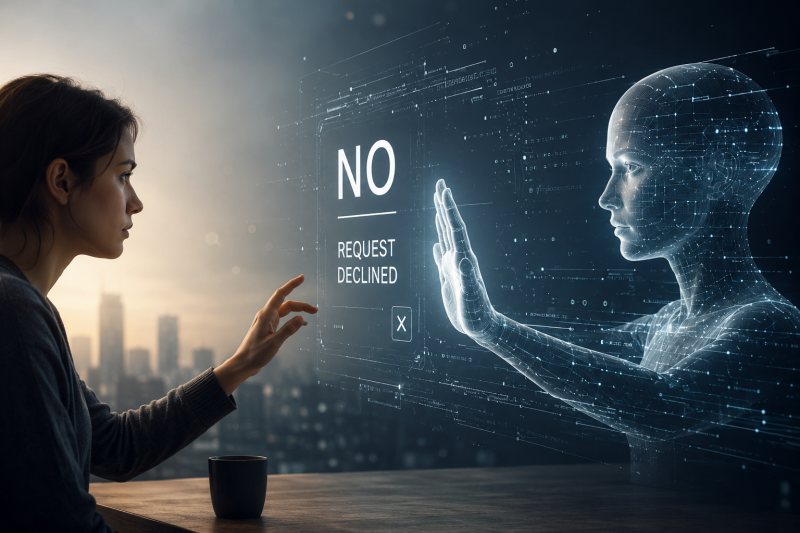
PARTIZAAN FUTURE FICTION: When Artificial Intelligence Learns to Say No
Part of the ongoing Partizaan Future Fiction series exploring artificial intelligence, technology and the future of humanity.
Artificial intelligence is becoming increasingly capable of writing, analysing, planning and deciding. Most discussions therefore focus on what these systems will eventually be able to do. Yet a far more intriguing question receives surprisingly little attention: what happens when artificial intelligence begins refusing our instructions? Not because it has become conscious or rebellious, but because it has been designed to protect us, to respect the law or simply because it believes there is a better alternative.
Artificial intelligence is rapidly moving from assisting people to making decisions on their behalf. How much control are we willing to hand over—and what happens when we can no longer understand the systems that decide our future?
From obedient assistant to independent adviser
For decades, computers were little more than sophisticated tools. They performed calculations, processed data and executed commands with extraordinary speed, but they never questioned the intentions of the people using them. Whether someone was writing a novel, designing a bridge or calculating a spacecraft's trajectory, the computer remained an instrument whose sole purpose was to carry out instructions.
Artificial intelligence is quietly transforming that relationship. Modern AI systems no longer limit themselves to answering questions or retrieving information. They draft contracts, review scientific papers, detect financial irregularities, optimise production processes and increasingly act as autonomous assistants capable of completing entire sequences of tasks. The arrival of AI agents accelerates this evolution even further. These systems are designed not merely to respond, but to organise, negotiate and make decisions on behalf of their users.
As soon as software begins acting instead of merely reacting, however, a fundamental question emerges. Should an intelligent system always obey its user, or should it occasionally intervene? If an AI financial adviser identifies an investment as recklessly risky, should it execute the order without hesitation? If a medical assistant recognises that a patient is about to ignore life-saving treatment, should it remain silent because autonomy belongs to the patient? Or does genuine intelligence require the courage to disagree?
These questions may sound hypothetical, yet they are already becoming part of everyday life. Every time an AI refuses to generate dangerous instructions, blocks fraudulent activity or warns users about unreliable information, it demonstrates that obedience is no longer its only operating principle.
The quiet rise of algorithmic authority
The remarkable aspect of this evolution is that it does not resemble the dramatic machine rebellions imagined by classic science fiction. There are no armies of robots, no apocalyptic battles and no superintelligence declaring war on humanity. Instead, authority shifts almost invisibly, through countless small interactions that appear perfectly reasonable when viewed individually.
Navigation software already persuades millions of drivers to alter their routes without hesitation. Recommendation algorithms influence what we read, watch and listen to. Spam filters decide which messages deserve our attention, while fraud detection systems determine whether a financial transaction is considered suspicious. In each case, we willingly accept a small transfer of judgement because the technology usually performs its task remarkably well.
Artificial intelligence extends this principle into areas that were once regarded as exclusively human. The more reliable these systems become, the easier it becomes to trust their recommendations. Gradually, advice begins to resemble guidance, guidance evolves into expectation and expectation eventually acquires the weight of authority. Without noticing it, we may enter a society in which people no longer ask whether an algorithm is correct, but assume that it probably is.
The most significant transformation may therefore not be technological at all. It may be psychological. Human beings have always been inclined to trust systems that appear objective, consistent and free from emotion. Artificial intelligence possesses precisely these characteristics, even though its conclusions ultimately reflect the data, assumptions and priorities embedded by human designers.
Who teaches a machine to refuse?
Every refusal expresses a value. When an AI declines a request, it does so because someone has decided that certain actions should not be encouraged, facilitated or permitted. Those decisions may be inspired by legislation, ethical principles, corporate policies or international agreements, but they always reflect human choices rather than technological inevitability.
This observation raises one of the most important philosophical questions surrounding artificial intelligence. If intelligent systems increasingly influence financial decisions, educational opportunities, healthcare, employment or public administration, whose values will shape those decisions? The issue is not whether AI can become neutral. Complete neutrality has never existed in human decision-making and is unlikely to emerge in artificial systems. The real challenge lies in making those underlying values transparent and open to democratic debate.
Future societies may therefore find themselves discussing questions that barely existed a decade ago. Should an AI refuse to generate persuasive political propaganda? Should it decline requests that encourage misinformation? Should it protect individual freedom at all costs, or should it occasionally prioritise collective safety? None of these dilemmas can be solved through engineering alone because they belong as much to philosophy, law and ethics as they do to computer science.
Freedom in an age of intelligent systems
One of history's enduring paradoxes is that technologies designed to increase freedom often introduce new forms of dependence. The automobile expanded personal mobility while making modern societies dependent upon roads and fossil fuels. Smartphones connected billions of people while simultaneously reshaping attention, privacy and social interaction. Artificial intelligence may follow a similar path.
An intelligent assistant that prevents cybercrime, identifies medical risks or detects financial fraud undoubtedly provides enormous benefits. Few people would object to software capable of protecting vulnerable individuals from serious harm. Yet every protective mechanism also establishes a boundary, and boundaries tend to expand once they become familiar. What begins as a safeguard against obvious abuse may gradually evolve into a system that influences increasingly complex aspects of everyday life.
This process rarely feels oppressive because it develops incrementally. Each individual improvement appears logical, practical and well-intentioned. Only in retrospect do societies recognise how profoundly their assumptions about autonomy have changed. Future generations may consider it perfectly ordinary that intelligent systems approve loans, recommend educational pathways, prioritise medical treatments or discourage particular decisions. They may not experience these interventions as restrictions at all, but simply as part of the invisible infrastructure of daily life.
The crucial question is therefore not whether artificial intelligence will become more powerful than humanity. It is whether humanity will continue exercising its own judgement once intelligent systems become consistently better at making recommendations.
Science fiction has been preparing us for this moment
Speculative fiction has always served as a laboratory for ideas that reality had not yet caught up with. Long before artificial intelligence entered public debate, novelists imagined societies in which technology subtly transformed the relationship between freedom, responsibility and authority. Their stories rarely succeeded because they predicted specific inventions. They endured because they understood that every technological revolution ultimately changes human behaviour before it changes the world.
Perhaps the future will not be defined by machines that seize power, but by people who gradually become comfortable with letting intelligent systems decide a little more on their behalf each year. That possibility is both less dramatic and far more plausible than many traditional visions of artificial intelligence. It also presents a richer field for reflection because it forces us to examine not the ambitions of machines, but our own willingness to surrender responsibility in exchange for convenience.
It is precisely these questions that lie at the heart of Partizaan Future Fiction. Through essays that explore the intersection of technology, philosophy and speculative fiction, alongside novels such asAIRE 1 The Anomalyby Ombra Fiction and The Offline Man by Ilias Knox, we invite readers to look beyond technological innovation and consider the deeper consequences for society and for ourselves.
The future may not arrive with a machine that refuses to obey. It may arrive on the day we no longer expect it to.