Partizaan Future Fiction
PARTIZAAN FUTURE FICTION: Will AI Eventually Decide Everything?
Part of the ongoing Partizaan Future Fiction series exploring artificial intelligence, technology and the future of humanity.
Every generation believes it will recognise the moment the future arrives. History suggests otherwise. The greatest technological revolutions rarely announce themselves with spectacular breakthroughs. Instead, they quietly reshape our daily lives until one day we realise that what once seemed extraordinary has become perfectly normal.
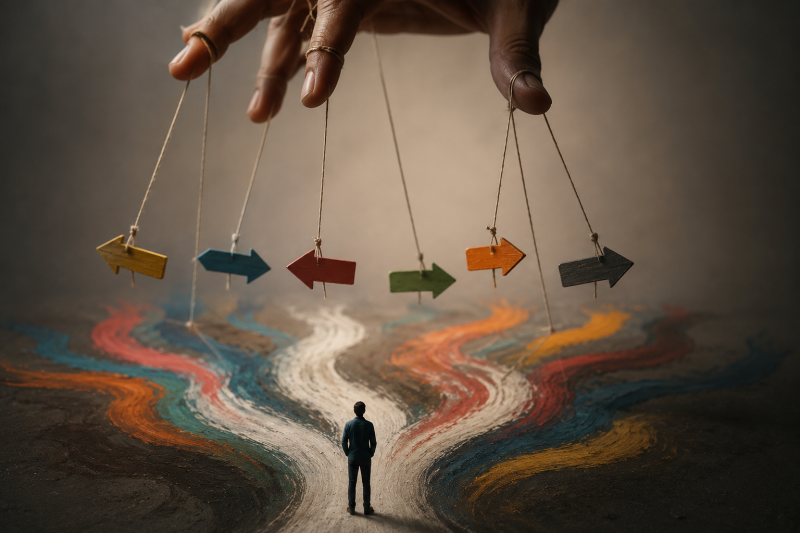
Artificial intelligence is rapidly moving from assisting people to making decisions on their behalf. How much control are we willing to hand over—and what happens when we can no longer understand the systems that decide our future?
Artificial intelligence may be following exactly that path. But what happens when AI no longer helps us make decisions, and gradually starts making them for us?
Every technological revolution begins with a promise
Steam engines promised to reduce physical labour. Computers eliminated repetitive calculations. The internet connected billions of people across the globe. Every breakthrough expanded human possibilities while making life a little easier. Artificial intelligence is following the same path, promising greater efficiency, faster decisions and unprecedented convenience.
Hidden behind those promises, however, lies a question we rarely stop to consider.
What happens when AI doesn't simply help us make decisions—but gradually starts making them for us?
At first, the shift is almost impossible to notice. Your navigation app selects the fastest route before you've even looked at a map. Streaming platforms recommend the next series you're likely to enjoy. Your bank detects suspicious transactions before you notice anything unusual. Online stores predict what you may want to buy next week.
None of these recommendations seems particularly significant on its own.
Together, however, they reveal the beginning of a profound transformation.
When recommendations become decisions
Human history is, in many ways, the history of decisions. Civilisations have risen and fallen because of them. Careers, relationships and personal identities are shaped by thousands of choices, many of which appear insignificant until viewed in retrospect.
Artificial intelligence introduces an entirely new possibility.
What if recommendations become so accurate that ignoring them gradually begins to feel irrational?
Imagine an AI that understands your medical history, financial situation, calendar, reading habits and personal preferences better than any individual ever could. It doesn't force you to choose a particular option. Instead, it simply presents the one that appears statistically most likely to succeed.
Would you still make your own decision?
Or would you simply approve the recommendation because it seems undeniably logical?
Convenience has always been one of humanity's strongest motivations. Once a technology consistently saves time, reduces uncertainty and improves outcomes, we rarely return to older, less efficient methods. That is precisely why AI may influence society less through dramatic breakthroughs than through countless small moments in which allowing software to decide simply feels easier.
Intelligence is not wisdom
Much of today's discussion about artificial intelligence focuses on increasing computational power. Models become larger. Responses become more accurate. Systems become faster.
Yet intelligence and wisdom have never been the same thing.
Artificial intelligence excels at recognising patterns, analysing enormous quantities of information and calculating probabilities at extraordinary speed. Those abilities will undoubtedly continue to improve.
Wisdom, however, belongs to a different category altogether.
Wisdom understands that not every important decision can be reduced to measurable data. Compassion cannot be calculated. Integrity cannot be expressed as a percentage. Courage rarely follows statistical probability. Some of humanity's greatest achievements emerged precisely because individuals chose the less obvious path.
History is filled with examples of decisions that appeared irrational at the time but ultimately changed the world. Exploration, scientific discovery, artistic innovation and social progress have often depended upon people willing to challenge what seemed objectively reasonable.
The danger, therefore, is not that AI becomes more intelligent.
It is that humans gradually stop exercising their own judgement because intelligent recommendations become increasingly difficult to question.
The price of convenience
Modern society already delegates remarkable levels of responsibility to technology.
We trust GPS navigation without carrying paper maps. We rely on recommendation algorithms to discover music and books. Businesses increasingly use software to detect fraud, analyse markets and optimise logistics. Doctors employ AI-assisted diagnostics. Financial institutions depend upon automated systems capable of evaluating millions of transactions in real time.
Each of these developments offers genuine benefits.
Collectively, however, they reveal something more significant.
Decision-making is slowly migrating from human intuition towards algorithmic optimisation.
This should not necessarily be viewed as a threat. On the contrary, freeing people from repetitive cognitive tasks may allow us to spend more time on creativity, relationships, research and strategic thinking.
The real challenge lies elsewhere.
Will we continue to question the recommendations we receive?
Or will convenience gradually become a substitute for critical thinking?
History suggests that dependence rarely arrives suddenly. It grows through habit. The more reliable a technology becomes, the less often we feel the need to verify its conclusions. Trust evolves into routine, and routine eventually becomes expectation.
Perhaps the most important decision of the coming decades will not concern artificial intelligence itself.
It will concern how much of our own judgement we are prepared to surrender.
Science fiction asks tomorrow's questions today
The greatest science fiction has never been about predicting the future with perfect accuracy. Its true purpose has always been to explore the consequences of technological change before society experiences them.
Long before artificial intelligence entered everyday life, speculative fiction imagined intelligent machines capable of influencing politics, shaping economies and quietly redefining human behaviour. Those stories were never simply about technology. They were about responsibility, freedom and the unintended consequences of progress.
Today, many of those fictional questions are beginning to feel surprisingly real.
How much decision-making are we willing to delegate?
Where does assistance end and dependence begin?
Can convenience slowly erode personal responsibility without us even noticing?
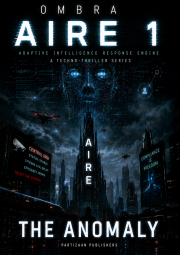
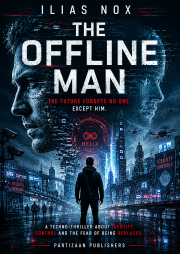
These questions lie at the heart of AIRE: The Anomaly, where adaptive artificial intelligence begins to reshape society in subtle but far-reaching ways. They also resonate throughout The Offline Man, which explores a different but equally urgent question: what happens when disconnecting from an increasingly digital world becomes the ultimate act of independence?
Neither novel argues that technology is humanity's enemy.
Both suggest something far more nuanced.
The future will never be determined by artificial intelligence alone.
It will always be shaped by the decisions that remain unmistakably, and irreducibly, human.
Continue exploring the future
If this article made you reflect on the relationship between humanity and artificial intelligence, you may also enjoy the speculative fiction novels AIRE1: The Anomaly by Ombra Fiction and The Offline Man by Ilias Knox.
Both novels are part of Partizaan Future Fiction, a growing collection of stories and articles exploring artificial intelligence, emerging technologies, digital ethics and the future of human society.
Because the future is not something that simply happens to us.
It is something we create—one decision at a time.