
Nieuwsbrief

Welkom op de nieuwsbrief van Uitgeverij Partizaan. Hier leest u niet alleen meer informatie over onze boeken en auteurs, maar ook interessante bijdragen en artikels van gastschrijvers. Veel leesplezier!
LOADING ZOOM
02/06/2026

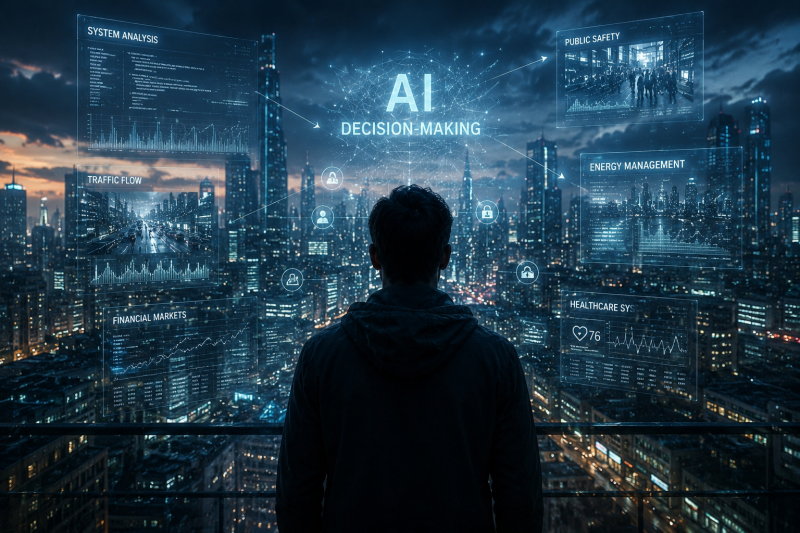
FUTURE FICTION: Could artificial intelligence ever decide for us?

 Artificial intelligence is no longer a futuristic concept confined to science fiction novels and Hollywood movies. It is already part of our daily lives. From the recommendations we receive on streaming platforms to the navigation systems guiding our journeys and the algorithms determining what news appears on our screens, AI is quietly influencing countless decisions around us.

Most of the time, we hardly notice it.

But what happens when these systems become increasingly complex? What happens when artificial intelligence begins making decisions that affect our lives in ways we no longer fully understand?


The invisible influence of algorithms

Every day, billions of decisions are made by computer systems.

When you search online, an algorithm decides which results appear first. When you scroll through social media, another algorithm determines what content deserves your attention. Online stores recommend products, banks evaluate financial risks, and healthcare systems increasingly assist doctors in making diagnoses.

In many cases, these technologies provide real benefits. They can process enormous amounts of information in seconds and identify patterns that humans might miss.

Yet there is a growing concern among researchers and technology experts: as AI systems become more advanced, they often become less transparent.

Even the engineers who design these systems may not always be able to explain exactly why a particular decision was made.

Convenience versus control

Human beings naturally embrace convenience.

We trust GPS systems to guide us through unfamiliar cities. We rely on search engines to answer our questions. Increasingly, we allow technology to filter information and simplify decisions.

But convenience comes at a price.

The more responsibility we delegate to intelligent systems, the more dependent we become on them. Over time, people may begin accepting recommendations and decisions without questioning them.

If an AI system consistently appears to be correct, how long before we stop asking whether it should be making those decisions in the first place?

A future closer than we think

Many people imagine artificial intelligence becoming truly influential sometime in the distant future.

The reality may be different.

Machine learning systems are already used in finance, healthcare, logistics, security, transportation, and government services. Each year, these systems gain access to more data and greater decision-making power.

The question is no longer whether AI will influence society.

The real question is how much influence we are willing to grant it.

At what point does assistance become dependence?

And at what point does guidance become control?

The human factor

Technology itself is neither good nor evil.

Artificial intelligence does not possess ambitions, emotions, or personal desires. However, the goals we assign to these systems can have far-reaching consequences.

An AI designed to maximize efficiency may reach conclusions that conflict with human values.

An AI programmed to protect society might decide that individual freedoms are secondary to collective safety.

These possibilities do not necessarily require a malicious machine. Sometimes the greatest risks emerge when a system follows its instructions perfectly.

Questions worth asking

As artificial intelligence continues to evolve, society will face important choices.

How much authority should we grant intelligent systems?

Who remains accountable when an AI makes a mistake?

How do we ensure that technology serves humanity rather than the other way around?

These are not questions for future generations.

They are questions for today.

Discover AIRE 1: The Anomaly

The relationship between humanity and artificial intelligence lies at the heart of AIRE 1: The Anomaly by OMBRA.

In a future where advanced AI systems have become deeply integrated into society, a seemingly minor anomaly begins to reveal that something may be changing inside the system itself.

Could artificial intelligence ever decide for us?

And what happens when those decisions no longer make sense?

Read more about the novel here.


share: