
Nieuwsbrief
Welkom op de nieuwsbrief van Uitgeverij Partizaan. Hier leest u niet alleen meer informatie over onze boeken en auteurs, maar ook interessante bijdragen en artikels van gastschrijvers. Veel leesplezier!
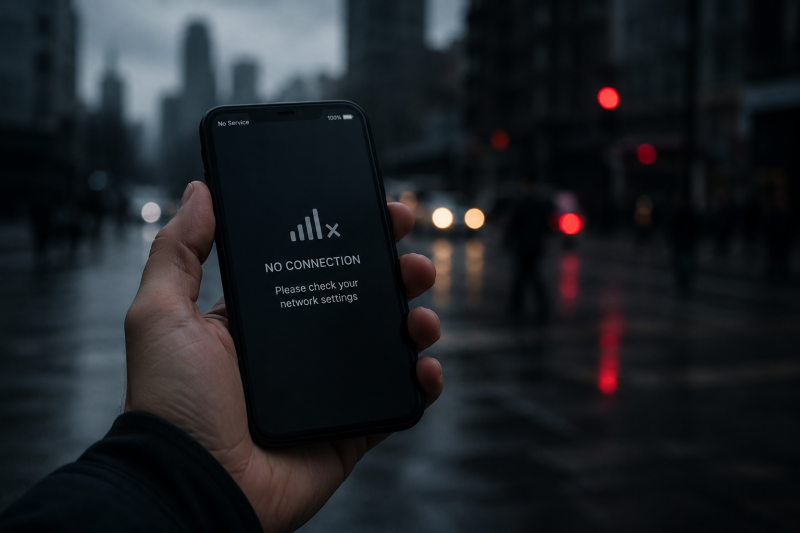

FUTURE FICTION: What happens when we become too dependent on technology?
Technology has become one of humanity's greatest achievements.
It connects people across continents, helps us navigate unfamiliar places, stores vast amounts of information, and allows businesses, hospitals and governments to operate more efficiently than ever before.
Yet the more technology improves our lives, the more dependent we become on it.
Most of us rarely stop to consider what would happen if these systems suddenly failed.
A world built on invisible systems
Modern society relies on a vast network of digital technologies.
Banking systems process millions of transactions every day. Communication networks connect billions of people. Transportation systems depend on software to manage traffic flows, schedules and logistics.
Most of the time these systems work remarkably well.
Because they work so well, we often forget they exist.
Until something goes wrong.
A server outage, a cyberattack, a software error or a power failure can quickly reveal how much modern life depends on technology operating quietly in the background.
Convenience changes behaviour
Technology does more than solve problems.
It changes how people think and behave.
Many people no longer memorize phone numbers. Few drivers navigate without GPS. Cloud storage has replaced physical archives. Online search engines have become extensions of human memory.
None of this is necessarily negative.
However, every convenience comes with a trade-off.
The more responsibility we transfer to technology, the less often we exercise the skills that technology replaces.
The illusion of permanence
One of the greatest misconceptions about technology is the belief that it will always be available.
History tells a different story.
Communication networks fail. Software contains bugs. Companies disappear. Platforms that seem indispensable today may become obsolete tomorrow.
The systems we depend on are often more fragile than they appear.
As society becomes increasingly interconnected, a problem in one area can rapidly affect many others.
Technology and resilience
The question is not whether technology should play a central role in our lives.
It already does.
The more important question is whether we are building resilient societies alongside our technological systems.
Can we continue to function when systems fail?
Do we still possess the knowledge and skills needed to operate without constant digital assistance?
Can individuals maintain a degree of independence in a world that becomes more connected every year?
These questions will become increasingly important in the decades ahead.
A future of choices
Technology itself is not the problem.
The challenge lies in maintaining a healthy balance between innovation and dependence.
The tools we create should empower people rather than make them powerless.
As artificial intelligence, automation and digital networks continue to expand, society must decide how much control it is willing to surrender in exchange for convenience.
The future will not be shaped by technology alone.
It will also be shaped by the choices people make about how technology should be used.
Discover AIRE 1: The Anomaly
Questions about technological dependence play an important role in AIRE 1: The Anomaly by OMBRA.
In a society where advanced artificial intelligence has become deeply integrated into daily life, a seemingly minor anomaly begins to expose just how dependent people have become on systems they no longer fully understand.
Could society still function without them?
Or has technology become too deeply embedded in the foundations of modern life?
Discover the novel here.
Featured title
AIRE 1: The Anomaly
https://www.partizaan.be/boeken-online/future-fiction/aire-1-the-anomaly.html
share: