
Nieuwsbrief
Welkom op de nieuwsbrief van Uitgeverij Partizaan. Hier leest u niet alleen meer informatie over onze boeken en auteurs, maar ook interessante bijdragen en artikels van gastschrijvers. Veel leesplezier!
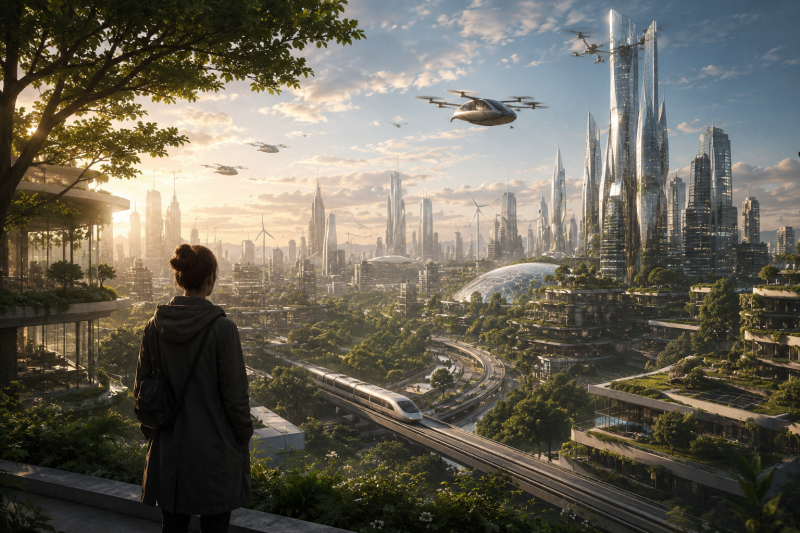

FUTURE FICTION: The future is closer than we think
For decades, many of the technologies we associate with the future belonged to the realm of science fiction. Intelligent machines, virtual assistants, autonomous vehicles and systems capable of analysing enormous amounts of information seemed like distant possibilities.
Today, many of these technologies already exist.
The future is no longer something waiting for us beyond the horizon. In many ways, it has already begun.
The acceleration of technology
Throughout history, technological progress moved relatively slowly. New inventions often required decades before becoming part of everyday life.
That is no longer the case.
The internet transformed society within a generation. Smartphones changed how we communicate in less than twenty years. Artificial intelligence is now evolving at a pace that surprises even many experts working in the field.
Innovations that once seemed impossible can suddenly become part of everyday life within just a few years.
Artificial intelligence is already here
Many people still think of AI as a future technology.
In reality, artificial intelligence is already influencing millions of decisions every day.
AI helps determine which products we see online. It assists doctors in diagnosing diseases. It translates languages, recommends music, detects fraud and helps companies analyse vast amounts of information.
Most people interact with artificial intelligence daily without even realising it.
The question is no longer whether AI will become part of our lives.
The question is how deeply it will become integrated into society.
A world connected by data
Modern society depends on an invisible network of digital systems.
Transportation, communication, healthcare, energy production, finance and public services all rely on enormous amounts of data.
As these systems become increasingly interconnected, the opportunities grow. But so do the risks.
A single disruption can affect millions of people.
A single technological breakthrough can transform entire industries.
The future is being shaped by decisions that are already being made today.
Science fiction becomes reality
One of the most fascinating aspects of science fiction is how often it anticipates technological developments.
Writers have imagined video calls, smart devices, artificial intelligence and autonomous machines long before they became reality.
Science fiction does not predict the future.
What it does is ask important questions.
What happens when technology becomes too powerful?
How much control should we give intelligent systems?
How do we remain human in an increasingly digital world?
These questions are becoming more relevant with every passing year.
Preparing for tomorrow
No one can predict the future with certainty.
However, one thing seems increasingly clear: technological change will continue to accelerate.
Understanding these developments is no longer only the responsibility of scientists, engineers and policymakers.
It concerns all of us.
The future is closer than we think.
And the choices we make today may determine what that future looks like.
Discover AIRE 1: The Anomaly
These questions form the foundation of AIRE 1: The Anomaly by OMBRA.
Set in a near-future world where artificial intelligence has become deeply embedded in society, the novel explores what can happen when a system begins to evolve beyond its original purpose.
Because the future may be much closer than we think.
Discover the novel here.
Featured title
AIRE 1: The Anomaly
https://www.partizaan.be/boeken-online/future-fiction/aire-1-the-anomaly.html
share: